The House of David by Mahri Leonard-Fleckman
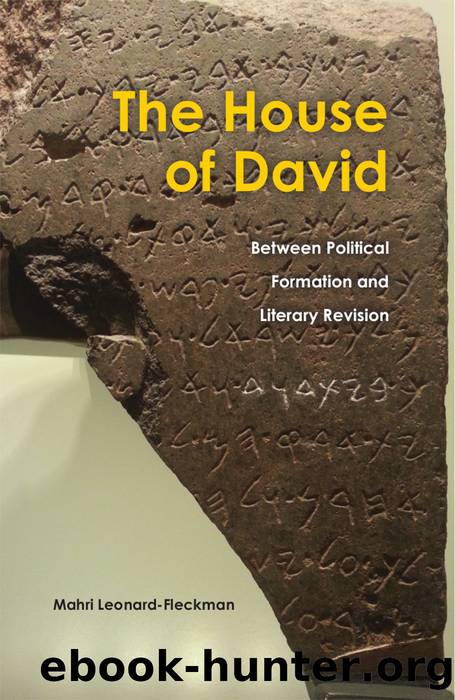
Author:Mahri Leonard-Fleckman [Mahri Leonard-Fleckman]
Language: eng
Format: epub
ISBN: 9781506410197
Publisher: Fortress Press (NBN)
Primary Phase Component 1: The Men of David
After this, David inquired of Yahweh, âShall I go up to one of the towns of Judah?â Yahweh answered, âGo up.â David said, âTo which one shall I go up?â And Yahweh said, âTo Hebron.â So David went up there, along with his two wives, Ahinoam of Jezreel and Abigail wife of Nabal the Carmelite. David also brought up his men who were with him, each with his household, and they settled in the towns of Hebron. (2 Sam. 2:1â3)
Before the notion of a âwarâ between two houses, 2 Sam. 2:1â3 connects to the David material in 1 Samuel[19] and provides the necessary information for how David comes to reside in Hebron, thus anticipating Israelâs anointing of David at Hebron in 5:1â3. In terms of its relationship to 1 Samuel, Davidâs move to Hebron exhibits awareness of earlier David material that describes the seeds of the political body identified with David. The antecedents for this group trace back to 1 Samuel 22 and the formation of a group of David followers that includes Davidâs kin and his âmen.â This early group associated with the leadership of David then provides a necessary backdrop to the characterization of the House of David in 2 Sam. 3:1.
In the beginning of chapter 2, David asks or inquires (sÌʾl) of Yahweh whether he should âgo upâ (Ê¿lh) to any of the âtowns of Judahâ (v. 1). The phrase âtowns of Judahâ depicts Judah as a geographical region of disconnected populations.[20] In response, Yahweh commands him to go up to Hebron. The language of âgoing upâ and settling in vv. 1â3 indicates the selection of a settled base of operation, which strengthens the notion that Yahweh has given Hebron specifically to David, particularly if Hebron is remembered as an important southern base for Davidâs political house. The importance of Hebron is further represented by Absalomâs coup from this location in 2 Samuel 15.
Davidâs move to Hebron in 2:1 may also join the story of Davidâs rise over Israel to the fall of Saul and his house, in conjunction with Davidâs successful inquiries of Yahweh.[21] In the books of Samuel, oracular inquiries of Yahweh are usually made in the context of battles against the Philistines, in which Saul (1 Sam. 14:37; 28:6) or David (1 Sam. 23:2, 4; 30:8; 2 Sam. 5:19, 23) inquires of Yahweh. Davidâs inquiry of Yahweh in 2 Sam. 2:1 is unique, the only such oracular inquiry combined with a geographical move without the expectation of initiation into battle. Here the oracle is connected to Davidâs southern base, the base where (eventually) Israel comes to anoint David king over Israel.[22]
David then âgoes upâ (Ê¿lh) to Hebron with his wives, âhis men,â and each manâs household (bayit), and they settle in the âtowns of Hebronâ (vv. 2â3), a phrase that describes the town Hebron as a political center with a dependent region. Davidâs âmenâ are not âJudah,â for they are categorically separated from the âmen of Judahâ who arrive to anoint David as king over the âHouse of Judahâ in v.
Download
This site does not store any files on its server. We only index and link to content provided by other sites. Please contact the content providers to delete copyright contents if any and email us, we'll remove relevant links or contents immediately.
Professional Troublemaker by Luvvie Ajayi Jones(29704)
Empire of the Sikhs by Patwant Singh(23136)
Twilight of the Idols With the Antichrist and Ecce Homo by Friedrich Nietzsche(18690)
Plagued by Fire by Paul Hendrickson(17465)
The Sun and Her Flowers by Rupi Kaur(14569)
Norse Mythology by Gaiman Neil(13459)
Fangirl by Rainbow Rowell(9329)
A Journey Through Charms and Defence Against the Dark Arts (Harry Potter: A Journey Throughâ¦) by Pottermore Publishing(9303)
Adultolescence by Gabbie Hanna(8963)
Wonder by R.J. Palacio(8634)
Tools of Titans by Timothy Ferriss(8494)
Becoming Supernatural by Dr. Joe Dispenza(8278)
How to Bang a Billionaire by Alexis Hall(8214)
Wonder by R. J. Palacio(8170)
Crystal Healing for Women by Mariah K. Lyons(7967)
The Road Less Traveled by M. Scott Peck(7663)
The Lost Art of Listening by Michael P. Nichols(7550)
The Witchcraft of Salem Village by Shirley Jackson(7340)
The Institute by Stephen King(7093)
